



Background
In North America, in particular, 1975 titanium were approved for use in the USA and there have been advocates for various femoral design. Other authors have been concerned that such devices whilst fitting and filling the femoral diaphysis may lead to proximal femoral resorption secondary to proximal stress shielding. Mallory and Head, amongst others, have preferred a proximally coated, tapered wedge design creating a mechanical interface, which as it subsides, maintains hoop stresses between itself and the bone.
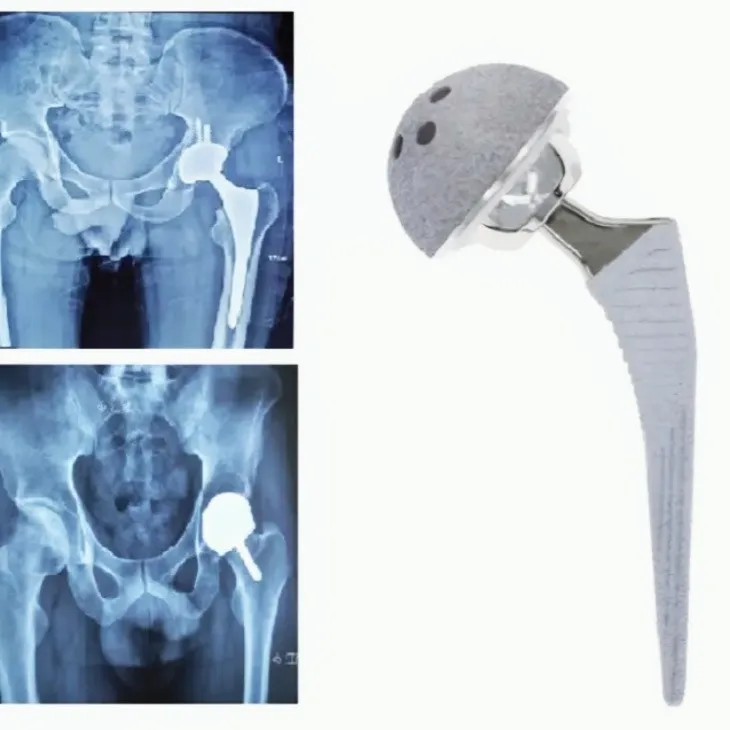
If the coating is confined to the metaphysis it must be circumferential to avoid uncoated areas allowing access for wear debris to pass distally. Good medium-term and some long-term successes have been reported by Bourne and Rorabeck, Rothman and others using proximally coated titanium alloy, ingrowth prostheses. Equally, Zweymuller has reported encouraging results with a stem of rectangular cross-section that provides initial"three-dimensional anchorage.Femur Prosthetic Replacement Titanium Rod had gradually put into the experimentals and operations.
Basic Information
Mechanical properties(Gr23)
|
Mechanical properties |
|||
|
Tensile strength, Mpa |
Yield strength, MPa |
Elongation, % |
Reduction of Area, % |
|
≧830 |
≧760 |
≧10 |
≧25 |
Chemical composition(Gr23)
|
Main Ingredients |
Remaining ingredients |
|||||||
|
Al |
V |
Fe |
C |
N |
H |
O |
Residuals |
|
|
each |
total |
|||||||
|
5.5-6.5 |
3.5-4.5 |
<0.25 |
<0.08 |
<0.03 |
<0.012 |
<0.13 |
<0.10 |
<0.30 |
Researches
Titanium Is A Promising Orthopedic Implant Material With Potential Use In Total Hip Arthroplasty with the accordance to the Strain-Magnitude-Based Bone Remodeling Theory, The Effect Of Implant Materials On Bone Remodeling Was Evaluated By Analyzing Bone Density Loss.
Bone Loss Around An Implant Depends Strongly On The Value Of The Elastic Modulus Of The Prosthesis. If A Femur Prosthetic Replacement Titanium Rod Implant Is Used Instead Of A Cobalt-Chromium Implant, The Volume Of Bone Lost By Density Decreases Dramatically.
Numerical Results Show That Both The Volume Of Bone Lost By Density And The Rate Of Bone Density Loss Decrease Linearly With Increasing Porosity. However, Increasing Porosity Decreases The Strength Of Porous Femur Prosthetic Replacement Titanium Rod. For The Material Design Of Titanium-Based Femoral Prostheses, Stress Analysis Is Required To Meet The Strength Requirements for the Femur Prosthetic Replacement Titanium Rod.
Hot Tags: femur prosthetic replacement titanium rod, China femur prosthetic replacement titanium rod manufacturers, suppliers, factory, TC20 Surgical Implants Titanium Plate, titanium bar rod, ASTM B348 Round Bar, Titanium Nuts, Dental Titanium Disc, titanium powder


