

Titanium Forging
Taitong Shengda Company,founded in 2018, is a comprehensive enterprise integrating scientific research, design, manufacturing, international trade, logistics and distribution. It has a professional production line of high-end titanium product at the advanced level in China. The standards include ASTM, ASME, AMS, DIN, NFL, TP, BS, ect, and obtain a number of national patents.
Why choose us?
Our factory
The total investment of the factory is RMB 15 million, covering an area of 5,500 square meters. It has a high-end professional titanium production line with international advanced level, and the annual output is stable at 3,000 tons.
Sales market
Our company's products are loved by a large number of domestic trading companies and are exported to India, Pakistan and European markets, due to the excellent product quality, it has received unanimous praise from buyers and has a stable customer base.
Our service
Professional sales team will answer all kinds of questions about the product in time, and provide product catalogs and samples. Real-time tracking of orders, let customers can know the progress and status of the order. We attach importance to customer feedback and provide trial orders and return and exchange services.
Product application
Medical devices and surgical implants, aerospace, chemical equipment manufacturing, high-end decorations, electronic products
-
 Ti6Al4V GR5 Titanium DiscProduct Name: Ti6Al4V GR5 Titanium DiscStandards: ASTM B381 / AMS 4928Applications: ChemicalAdd to Inquiry
 -
 Grade 7 Titanium Screws And NutsSize:M1.6-M24mmColor: blue,red,purpleApplication:bike,industry,motorcycleTechnique:cncAdd to Inquiry
 -
 M5×0.8 Titanium Alloy BoltBrand name: MediTiProduct Material: GR5,GR23ELIThread Standard: Metric M5x0.8Standard: ASM,,DIN,Add to Inquiry
 -
 TC4 Titanium DiscsIntroduction:Standard: ASTM F136 ASTM F67Size: 10mm, 12mm, 14mm, 16mm, 18mm, 20mm, 22mm,Add to Inquiry
 -
 Vehicles Used Titanium Screws And NutsBrand name: MediTi. Standard: ASM,,DIN, BS, ANSI, JIS. Shape: round head, big head, flat head.Add to Inquiry
 -
 Auto Modification of Titanium Alloy ScrewsBrand name: MediTi. Standard: GB, DIN, BS, ANSI, JIS . Material: titanium,titanium alloy .Add to Inquiry
 -
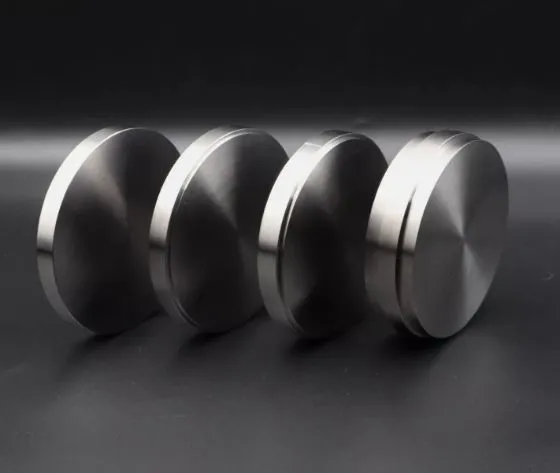 Dental Titanium DiscProduct name: dental titanium disc. Standard: ASTM F67. Diameter: 98/98.5mm. Thickness:Add to Inquiry
 -
 Titanium BlockApplication: medical, industrial. Thickness: 10~100mm. Width: ≤500mm (minimum). Length: ≤1000mmAdd to Inquiry
 -
 Medical Titanium ScrewsBrand name: MediTi. Standard: GB, DIN, BS, ANSI, JIS. Shape: round head, big head, flat head.Add to Inquiry
 -
 Titanium NutsMaterial: titanium alloy. Surface treatment: passivation, sandblasting, oxidation, polishing, etc.Add to Inquiry
 -
 Titanium WasherMaterial: Grade 5 Titanium. Product Type: Washer. Thickness: 1.0 mm. Thread Diameter: 5 mm. OuterAdd to Inquiry
 -
 Titanium Retaining RingBrand name: MediTi. Product name: titanium retaining ring. Grade: Gr1 Gr2 Gr5 Gr9 Gr12. Standard:Add to Inquiry


Benefits of Titanium Forging
Enhanced mechanical properties
One of the primary advantages of titanium forging is the enhancement of mechanical properties. The forging process aligns the metal's grain structure, resulting in improved strength and toughness. Forged titanium components exhibit superior fatigue resistance, making them ideal for applications subjected to cyclic loading.
Weight reduction
In industries where weight is a critical factor, such as aerospace and automotive, titanium forging offers significant weight reduction without compromising strength. The lightweight nature of titanium allows for the design of more efficient structures, leading to improved fuel efficiency and performance.
Corrosion resistance
Titanium's exceptional corrosion resistance is a significant advantage in many applications. Forged titanium components can withstand harsh environments, reducing the need for protective coatings and maintenance. This property is particularly valuable in industries such as oil and gas, where equipment is often exposed to corrosive substances.
Design flexibility
Titanium forging allows for greater design flexibility compared to other manufacturing processes. The ability to create complex shapes and geometries enables engineers to optimize designs for performance and functionality. This flexibility is crucial in industries where innovation and customization are essential.
Cost-effectiveness
While titanium is often perceived as an expensive material, the long-term cost-effectiveness of titanium forging should not be overlooked. The durability and longevity of forged titanium components can lead to reduced maintenance and replacement costs over time. Additionally, the efficiency of the forging process can result in lower production costs for high-volume applications.
Types of Titanium Forging Process


Hammer forging
In general, hammer forging is accomplished between two flat moulds or section moulds without moulding chamber. The tool utilized in hammer forging has simple shap, high flexibility, short manufacturing cycle and low cost. Therefore, it is only applicable in a few instances where the product’s performance has no specific criteria.
Open-die forging
The blank deforms between two chambers in the modules. The forgings are restricted inside the chambers. Excess metal flows out of a narrow slit between the two molds, forming burrs around the forgings. The metal is forced into the shape of the chamber by the resistance of the die and the surrounding burrs.
Closed-die forging
During closed die forging, no transverse burrs are formed perpendicular to the direction of die motion. The chamber of closed die has two functions: Shaping and guiding the blank.
No-draft forging
There are two types of no-draft forging: Extrusion die forging and reverse extrusion die forging. No-draft forging can produce all kinds of hollow and solid pieces with great accuracy size and denser interior structures.
Multi-ram die forging
In addition to the vertical punching plunger, there are two horizontal plungers. The ejector is used for punching. The ejector pressure is higher than that of a typical hydraulic press ejector. During multi-ram die forging, the slider operates alternately and jointly from both vertical and horizontal directions on the workpiece.one or more punch holes are employed to cause the metal to flow outward from the center of the die cavity in order to fill the die chamber. There are no specific forging burrs on the barrel components’ parting line.
Partial die forging
Sectional die forging, pad forging, and other partial die forging techniques can be utilized to forge large integral forgings under the current hydraulic pressure. Because the forgings are processed one segment at a time using the partial die forging technique, the equipment tonnage needed can be small. In general, this technique may be applied to medium-sized hydraulic presses to treat large forgings.
Isothermal die forging
Prior to forging, the die is heated to the forging temperature of the blank. The die and blank are maintained at the same temperature throughout the die forging process. Therefore, substantial deformation may be produced with tiny deformation forces. Isothermal die forging is comparable to isothermal superplastic die forging, with the exception that the blank is superplastically treated prior to die forging in order to generate equiaxed grains.
Application of Titanium Forging
Aerospace: Used in aircraft components, engine parts, landing gear, and structural elements due to their high strength, lightweight properties, and resistance to extreme temperatures.
Medical: Titanium forgings are ideal for producing biocompatible implants, surgical instruments, and prosthetics, offering durability and compatibility with the human body.
Marine: Forged titanium components are used in shipbuilding, offshore structures, and marine equipment, thanks to their excellent corrosion resistance in seawater.
Automotive: Applied in high-performance vehicle parts like engine components, suspension systems, and exhausts, where strength and weight reduction are critical.
Industrial applications: Titanium forgings are used in chemical processing, power generation, and oil & gas equipment, where corrosion resistance and durability in harsh environments are essential.
Defense: Titanium forgings are used in military vehicles, armor, and weaponry, providing high strength, lightweight, and durability in critical defense applications.
Shipping methods
We support air, sea and rail transportation.
Delivery time
Our delivery time is generally 15 days. The company promises to produce products efficiently within the specified time and fulfill its obligations in accordance with the contract.
Certificate


As one of the most professional titanium forging manufacturers and suppliers in China, we're featured by quality products and low price. Please rest assured to buy bulk discount titanium forging from our factory. For customized service, contact us now.
Titanium Washer, Titanium Nuts, Titanium Block