

Medical titanium screws are crucial components in the medical field, widely used in orthopedic surgeries, dental implants, and other medical applications. As a supplier of medical titanium screws, I am often asked about the manufacturing process of these essential medical devices. In this blog post, I will take you through the step-by-step process of how medical titanium screws are made.
Raw Material Selection
The first and most critical step in manufacturing medical titanium screws is the selection of raw materials. Titanium is chosen for its excellent biocompatibility, high strength-to-weight ratio, and corrosion resistance. Medical-grade titanium, such as Ti-6Al-4V (Grade 5) and Ti-6Al-7Nb (Grade 23), are commonly used due to their superior mechanical properties and low toxicity.
We source our titanium from reputable suppliers who adhere to strict quality control standards. The raw titanium is typically in the form of bars or rods, which are then inspected for any defects or impurities. This initial inspection ensures that only high-quality titanium is used in the manufacturing process. For example, we might use a Titanium Block as a starting material, which provides a solid foundation for the subsequent steps.
Forging
Once the raw material is selected, the next step is forging. Forging is a process that involves shaping the titanium by applying compressive forces. This process helps to improve the mechanical properties of the titanium, such as its strength and toughness.
The titanium bar or rod is heated to a specific temperature, usually between 800°C and 1000°C, depending on the type of titanium alloy. At this temperature, the titanium becomes malleable and can be easily shaped. The heated titanium is then placed in a forging press, where it is hammered or pressed into the desired shape. This process can be done using open-die forging or closed-die forging, depending on the complexity of the screw design.
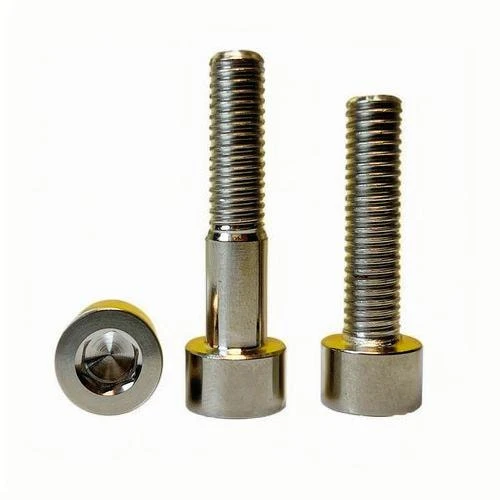

Open-die forging is suitable for simple shapes, while closed-die forging is used for more complex geometries. During closed-die forging, the titanium is placed in a die cavity that has the exact shape of the screw. The die is then closed, and the titanium is forced to fill the cavity, taking on the shape of the screw. This process ensures high precision and consistency in the screw's dimensions.
Machining
After forging, the titanium blank is ready for machining. Machining is a process that involves removing excess material from the titanium blank to create the final shape of the screw. This process includes turning, milling, drilling, and threading.
Turning is the process of rotating the titanium blank on a lathe while a cutting tool removes material from the outer surface. This process is used to create the cylindrical shape of the screw. Milling is similar to turning, but it involves using a rotating cutting tool to remove material from the surface of the titanium blank. Milling is used to create flat surfaces, grooves, and other features on the screw.
Drilling is the process of creating a hole in the titanium blank. This hole is used for various purposes, such as inserting a guide wire or for the passage of fluids. Threading is the process of creating the threads on the screw. This is done using a threading tool, which cuts the threads into the surface of the titanium blank.
During the machining process, strict quality control measures are in place to ensure that the screw meets the required specifications. The dimensions of the screw, such as its diameter, length, and thread pitch, are carefully measured using precision measuring tools. Any deviations from the specifications are corrected immediately to ensure the quality of the final product.
Heat Treatment
Heat treatment is an important step in the manufacturing process of medical titanium screws. Heat treatment helps to improve the mechanical properties of the titanium, such as its strength, hardness, and ductility.
There are several types of heat treatment processes that can be used for titanium screws, including annealing, solution treatment, and aging. Annealing is a process that involves heating the titanium to a specific temperature and then cooling it slowly. This process helps to relieve internal stresses in the titanium and improve its ductility.
Solution treatment is a process that involves heating the titanium to a high temperature and then quenching it in water or oil. This process helps to dissolve any precipitates in the titanium and improve its strength. Aging is a process that involves heating the titanium to a lower temperature and holding it at that temperature for a specific period of time. This process helps to precipitate fine particles in the titanium, which further improves its strength and hardness.
The heat treatment process is carefully controlled to ensure that the mechanical properties of the titanium screw meet the required specifications. The temperature, time, and cooling rate are all critical factors that need to be carefully monitored during the heat treatment process.
Surface Treatment
Surface treatment is the final step in the manufacturing process of medical titanium screws. Surface treatment helps to improve the biocompatibility and corrosion resistance of the titanium screw.
One of the most common surface treatment methods for medical titanium screws is passivation. Passivation is a process that involves treating the titanium screw with a chemical solution to remove any surface contaminants and create a thin oxide layer on the surface of the titanium. This oxide layer helps to protect the titanium from corrosion and improve its biocompatibility.
Another surface treatment method is coating. Coating involves applying a thin layer of material, such as hydroxyapatite or titanium nitride, on the surface of the titanium screw. Hydroxyapatite is a bioceramic material that is similar to the mineral component of bone. Coating the titanium screw with hydroxyapatite can help to promote bone growth and improve the integration of the screw with the surrounding bone tissue. Titanium nitride is a hard and wear-resistant material that can help to improve the durability of the screw.
Quality Control
Throughout the manufacturing process, strict quality control measures are in place to ensure the safety and effectiveness of the medical titanium screws. Quality control starts with the selection of raw materials and continues through every step of the manufacturing process, including forging, machining, heat treatment, and surface treatment.
We use a variety of quality control tools and techniques, such as non-destructive testing, dimensional inspection, and mechanical testing. Non-destructive testing methods, such as ultrasonic testing and X-ray inspection, are used to detect any internal defects in the titanium screw. Dimensional inspection is used to ensure that the screw meets the required specifications in terms of its diameter, length, and thread pitch. Mechanical testing, such as tensile testing and hardness testing, is used to evaluate the mechanical properties of the screw.
In addition to these in-house quality control measures, our medical titanium screws are also subject to external regulatory requirements. We comply with all relevant international standards and regulations, such as ISO 13485 and FDA regulations, to ensure the safety and effectiveness of our products.
Conclusion
The manufacturing process of medical titanium screws is a complex and highly regulated process that requires strict quality control measures at every step. From raw material selection to surface treatment, each step plays a crucial role in ensuring the safety and effectiveness of the final product.
As a supplier of medical titanium screws, we are committed to providing high-quality products that meet the needs of our customers. Our M5×0.8 Titanium Alloy Bolt and Grade 7 Titanium Screws And Nuts are just some of the products that we offer, which are manufactured using the latest technologies and strict quality control measures.
If you are interested in purchasing medical titanium screws or have any questions about our products, please feel free to contact us. We would be happy to discuss your requirements and provide you with more information about our products and services.
References
- ASTM International. (2023). Standard Specification for Wrought Titanium-6 Aluminum-4 Vanadium Alloy for Surgical Implant Applications (UNS R56400). ASTM F136 - 13(2023).
- ISO. (2016). ISO 13485:2016 - Medical devices -- Quality management systems -- Requirements for regulatory purposes.
- Ratner, B. D., Hoffman, A. S., Schoen, F. J., & Lemons, J. E. (Eds.). (2012). Biomaterials science: An introduction to materials in medicine. Academic press.


