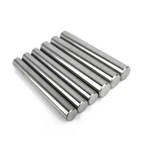
Difinition and brief introduction
The shrinkage of titanium rods refers to the process of gradually reducing the diameter of titanium rods through processing at one or both ends. This technology is used in many industries, mainly to meet specific connection or assembly requirements.
The shrinkage of titanium rods for spinal screws is less than or equal to 0.03mm, which is a strict requirement for the shrinkage processing accuracy of titanium rods.
The following are some key points about the shrinkage of titanium rods:
1. Narrowing accuracy requirements:
Dimensional tolerance: The diameter variation range of the narrowing part must be controlled within ±0.03mm.
Consistency: Regardless of batch production or single-piece processing, the shrinkage size needs to be highly consistent to ensure the matching accuracy with the spinal screw.
2. Why are the requirements so strict?
Assembly accuracy: The connection between the spinal screw and the titanium rod requires extremely high precision to ensure stability and mechanical properties after implantation.
Reduce stress concentration: Accurate shrinkage can reduce stress concentration at the connection site and reduce the risk of implant breakage or loosening.
Biocompatibility: Precise processing can avoid wear or foreign body reaction caused by dimensional errors and improve the biocompatibility of implants.
3. Purpose and Usage
Connection requirements: Narrowing can make it easier to connect titanium rods to other parts, such as through threads, slots or other mechanical connections.
Sealing performance: In some applications, shrinking can also improve sealing performance and ensure that the connection will not leak.
Structural strength: Through the shrinking process, the structural strength of the connection can be improved without significantly increasing the weight of the material.
4. Processing method
Heat shrinkage: Heat one end of the titanium rod to soften it and then plastically deform it to form a shrinkage.
Cold shrinkage: The end of the titanium rod is shrunk by mechanical pressure or rolling at room temperature.
Cold shrinkage: The end of the titanium rod is shrunk by mechanical pressure or rolling at room temperature.
5.Appearance characteristics
Conical necking: The necking part is conical, and the diameter gradually decreases from the main body of the rod, with a smooth transition. This is the most common necking form.
Step necking: The necking part is step-shaped, and the diameter is suddenly or staged. It is suitable for scenes that require clear size changes.
Arc necking: The necking part has an arc transition, and the diameter changes more gently, which is suitable for occasions where stress concentration needs to be reduced.
6.Typical appearance examples
Tapered necking: Similar to the shape of a sharpened pencil, the necking part gradually transitions from a large diameter to a small diameter, and the transition area is longer.
Short necking: The necking part is shorter and the diameter changes faster. It is usually used in scenarios where the diameter needs to be reduced quickly.
Inner necking: The necking direction is inward, forming a cavity with a gradually decreasing inner diameter, which is suitable for scenarios that need to cooperate with internal components
7. Appearance in actual application
Threaded necking: threads are processed on the necking part for connection with nuts or other parts.
Smooth necking: the necking part has a smooth surface, which is suitable for scenes that require direct insertion or assembly.
Special shape: according to specific needs, the necking part may be processed into special shapes, such as grooves, flanges, etc.
8. Visual reference
Imagine a straight rod tapering to a point or a small diameter cylinder at one end. This is a common taper shape.
If it is a step taper, you will see a straight rod with a sudden decrease in diameter at one end, forming a noticeable step.