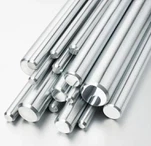
Titanium metal has very good properties, light weight, but high strength, ranking first among metals, and also has very high corrosion resistance. It has a wide range of applications in aerospace, biomedical engineering and other fields. So what is the difference between pure titanium and titanium alloy?
The difference between pure titanium and titanium alloy:
1. Different titanium content: Pure titanium is a silvery-white metal, and titanium alloy refers to various alloys made of titanium and other metals.
2. Different density: The density of titanium is 4.54g/cm3, which is 43% lighter than steel, higher than aluminum, but lower than steel, copper and nickel. Its specific strength ranks first among metals. The density of titanium alloy is usually about 4.51g/cm3, which is only 60% of steel. Pure titanium is a silvery-white metal with many excellent properties, such as light weight, high strength, metallic luster, and resistance to wet chlorine corrosion. The density of titanium is lighter than steel, but its mechanical strength is similar to that of steel, twice that of aluminum, and five times that of magnesium. Titanium is resistant to high temperatures, with a melting point of 1942K, which is nearly 1000K higher than gold and 500K higher than steel. Titanium alloy refers to various alloy metals made of titanium and other metals. Titanium alloy has the advantages of high strength, good corrosion resistance and high heat resistance. Titanium alloy accounts for only 60% of steel, and the strength of some high-strength titanium alloys exceeds that of many alloy structural steels.
Among titanium metals, Shanghai titanium plates, titanium rods, titanium tubes, etc. all contain pure titanium and titanium alloys.
The significant difference between pure titanium and titanium alloys is that titanium alloys are based on pure titanium and add chemical substances such as Al, Mo, Cr, Sn, etc., and it is precisely because of these chemical substances that the two titanium metals differ in performance.
1. Classification of pure titanium:
According to the impurity content, titanium is divided into high-purity titanium (purity of 99.9%) and industrial pure titanium (purity of 99.5%). Industrial pure titanium has three grades, represented by TA+sequence number 1, 2, and 3 respectively. The larger the number, the lower the purity.
2. Properties of pure titanium:
Ti: 4.507 g/cm3, Tm: 1688℃. It has an allotropic transition, ≤882.5℃ is the α phase of the close-packed hexagonal structure, ≥882.5℃ is the β phase of the body-centered cubic structure.
Pure titanium has low strength, but high specific strength, good plasticity, good low-temperature toughness, and high corrosion resistance. Titanium has good pressure processing performance, but poor cutting performance. Titanium can burn when heated in nitrogen, so argon should be used for protection when heating and welding titanium.
3. Uses of pure titanium:
The impurity content has a great influence on the performance of titanium. A small amount of impurities can significantly improve the strength of titanium. Therefore, industrial pure titanium has a high strength, close to the level of high-strength aluminum alloys. It is mainly used to manufacture petrochemical heat exchangers, reactors, ship parts, aircraft skins, etc. that work at temperatures below 350℃.
The significant difference between pure titanium and titanium alloy is that titanium alloy is based on pure titanium with the addition of chemical substances such as Al, Mo, Cr, Sn, etc. It is precisely because of these chemical substances that the two titanium metals differ in performance.